
Lady Whistledown’s Guide to dtSearch Etiquette
On the Proper Conduct of Search Terms in Polite (and Indexed) Society
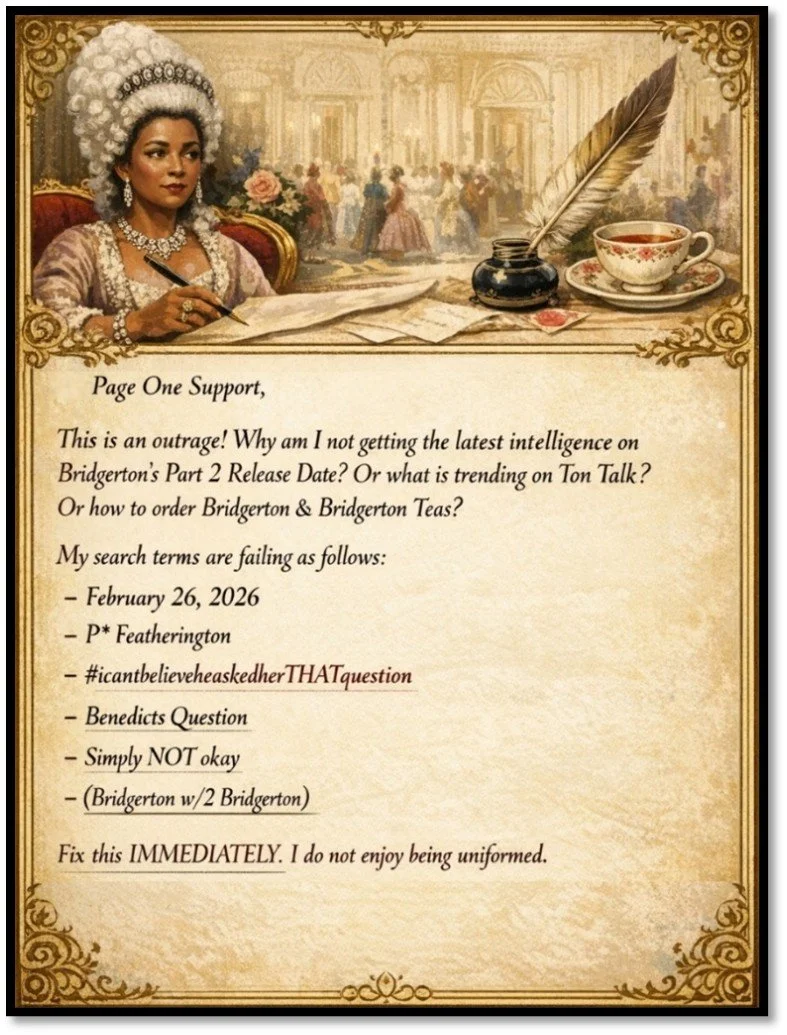
Dearest Gentle Reader,
There are spectacles that unfold beneath chandeliers — fans fluttering, pearls clutched, reputations trembling.
And then, there are the quieter disgraces. The kind that occur not in drawing rooms, but in a dtSearch index.
Unlike civilized society, dtSearch offers no polite forgiveness for imprecision. It executes exactly what is written — every operator, every wildcard, every misplaced symbol. Often leading to results that are technically correct but disastrously amiss.
And so it is with Her Majesty’s inquiry into Ton Talk, a lively corner of our Bridgerton-inspired data set. And we know Her Majesty does not enjoy being uninformed.
Let us restore order to her search terms with haste.
The Queen’s Term: P* Featherington
Page One’s Revision: (Pen* w/2 (Bridgerton OR Featherington)) OR "Lady Whistledown"
Why Precision Demanded Change:
Ah yes — the reckless wildcard.

P* throws open the ballroom doors to hits on Penelope’s sisters, Prudence and Philippa, and any other opportunistic “P” lurking in the index next to a Featherington. And yet, in its chaotic generosity, this term still misses married names, aliases, nicknames, and variations in spacing.
Both too broad. And too narrow.
A rare and impressive failure.
Proper normalization requires refinement. Pen* narrows intention; w/2 allows civilized flexibility in order and adjacency; and including "Lady Whistledown" ensures no carefully guarded identity escapes notice.
Wildcards are to be wielded with restraint. They are instruments of precision — not confetti to be tossed about the ballroom.
The Queen’s Term: February 26, 2026
Page One’s Revision: date(02/26/2026)
Why Precision Demanded Change:
dtSearch catalogs dates with the diligence of a well-trained footman, yet it cannot read minds. Only the correct syntax shall return both “February 26, 2026” and 2/26/2026.
Now, every mention of the Part 2 premiere date shall be laid bare for the Queen.
The Queen’s Term: #icantbelieveheaskedherTHATquestion
Page One’s Revision: icantbelieveheaskedherTHATquest*
Why Precision Demanded Change:
Scheming symbols are never mere adornments: ?, %, ~, &, = all require the utmost care, lest your carefully crafted search descend into chaos. And the # is a particularly devious phonetic operator—capable of twisting the very logic of your search if left unescaped.
Don’t believe me? Consider the plight of poor Francesca, who, in pursuit of #pinnacle, returned the most irrelevant results for “phoenix-like”.
But symbols are not the only problem with this term, dtSearch, most regrettably, indexes only the first 32 characters of a contiguous string. By truncating intentionally and adding a wildcard, we regain control of what would otherwise be lost to indexing limits.
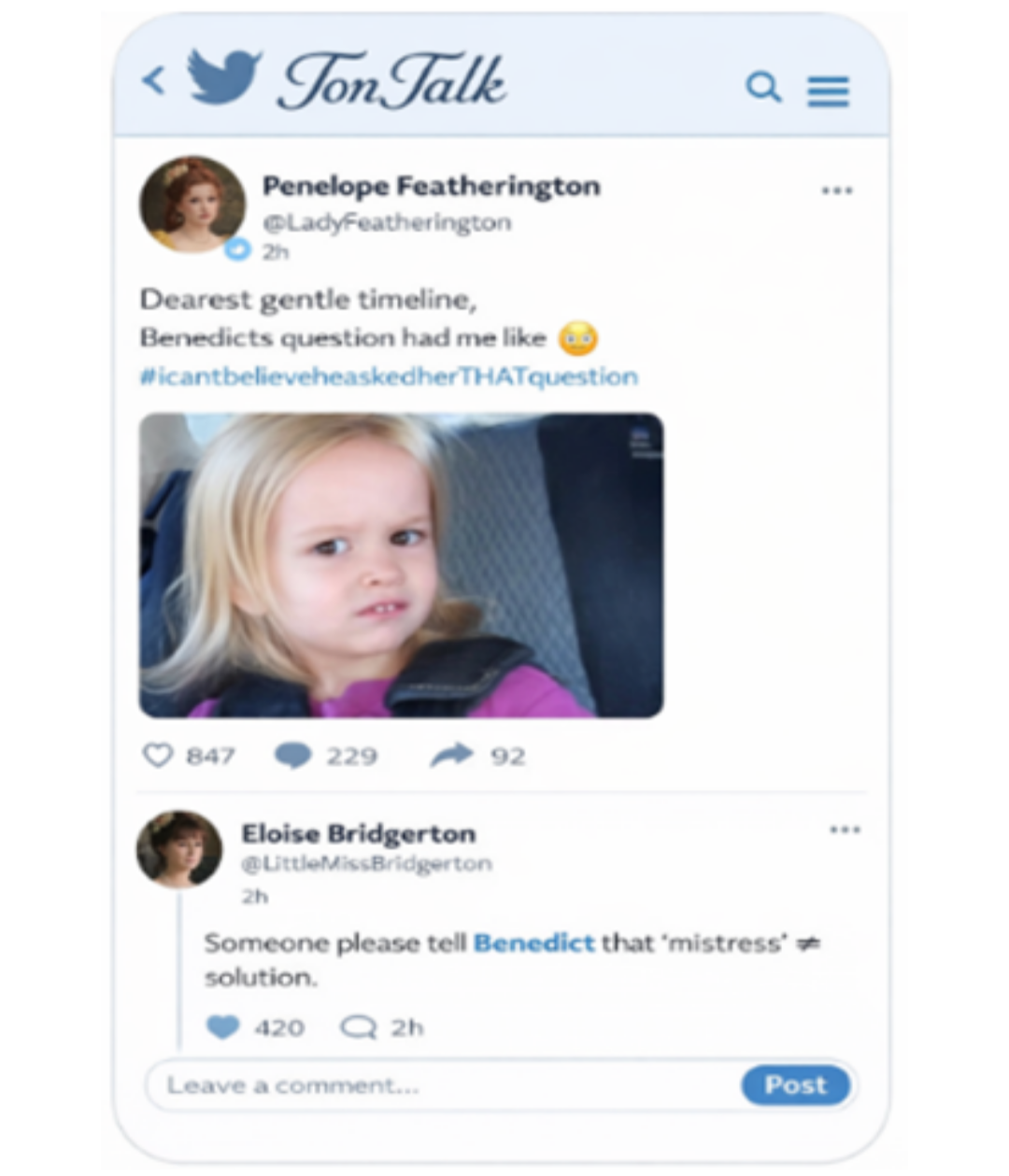
The Queen’s Term: Benedicts Question
Page One’s Revision: Benedict* w/2 (Question OR "##\?")
Why Precision Demanded Change:
Apostrophes, those dainty little marks of possession, create word breaks in dtSearch. Thus, “Benedict’s” and “Benedicts” do not behave identically. By normalizing this term to:
“Benedict* w/2” we ensure that both variations are invited to the party.
But the true mischief lies in the question mark. In dtSearch, ? is not punctuation — it is a single-character wildcard. If you intend to search for a literal question mark, you must escape it properly: "##\?"
With this adjustment, Her Majesty may now witness every horrified reaction to Benedict’s most scandalous question.
The Queen’s Term: Simply NOT okay
Page One’s Revision: "Simply NOT okay"
Why Precision Demanded Change:
Oh, how swiftly dtSearch misinterprets! Without quotes, dtSearch’s NOT is merciless. Your phrase becomes a scandalous opposite, returning anything with “simply” and hiding what is truly “NOT okay.” Enclose your phrase in quotes if you wish to capture the intended outrage.
The Queen’s Term: (Bridgerton w/2 Bridgerton)
Page One’s Revision: ("Bridgerton and Bridgerton" OR "Bridgerton & Bridgerton") w/5 tea*
Why Precision Demanded Change:
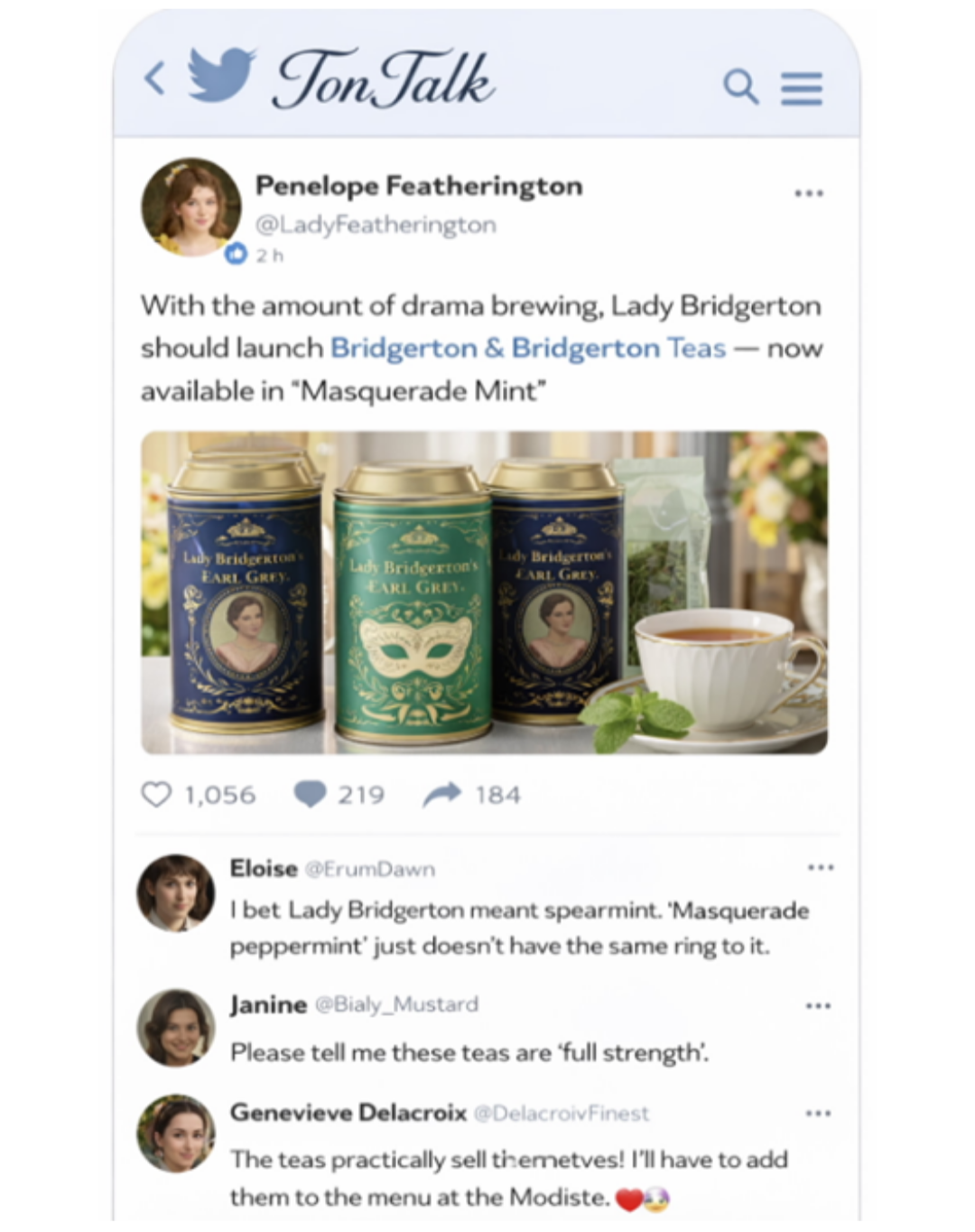
Lady Bridgerton may serve herself as tea, but if Her Majesty wishes to know that the Modiste will soon be offering Bridgerton & Bridgerton Teas, dtSearch requires explicit phrase variations and a careful anchor of tea* to keep the results relevant. This is because searching a word near itself returns every singular instance of that word — a most unrefined result.
Closing Thoughts on Search Decorum
Now that Her Majesty’s terms are properly normalized and the gossip of Ton Talk lies fully revealed, allow this guide to serve as your reminder: dtSearch precision is not ornamentation — it is infrastructure.
Search term normalization shapes defensibility, reporting accuracy, and every workflow that follows. A careless wildcard today becomes a distorted Search Term Report tomorrow.
For in polite society — and in indexed ones — precision is strategy.
Yours Truly,
Lady Whistledown (courtesy of PageOne)
P.S. For those who prefer their etiquette distilled into essentials, a brief reminder of dtSearch decorum:
📜 Wildcards: Use with precision (* and ?)
📜 Proximity Operators: w/n keeps words elegantly close without chaos.
📜 Special Characters: Symbols like # ? % & ~ = must be normalized properly.
📜 Date Syntax: Use date(mm/dd/yyyy) to ensure complete results.
📜 Apostrophes & Possessives: Leverage wildcards and proximity indicators to capture all variations.
📜 Boolean Logic: Mind NOT, OR, AND — without quotes, they misbehave.
📜 Phrase Variations: Include natural variations (and vs &) to capture all relevant mentions. Searching a “word” w/2 “word” will summon every singular instance — whether or not it pairs elegantly.