
Falling in Love with Your Data: A Valentine’s Guide to Sentiment Analysis
Valentine’s Day is all about noticing the unspoken — the glances, the hints, and the tiny sparks that make life interesting. Your documents are no different. Every email, memo, and note carries tone and intent that can be challenging to quantify. With Sentiment Analysis in RelativityOne, you can uncover the emotions behind every sentence.
Love at First Insight: When Sentiment Analysis Gets It Right
What makes Sentiment Analysis remarkable is its ability to infer intent — not just detect words. It can recognize excitement, sarcasm, and subtle frustration with impressive intuition. To see how it works, let’s explore three quotes from our Bridgerton dataset.
Example: Detecting Charm
Quote: “Dearest gentle reader, Did you miss me?”
Positive Score: 80%
Insight: Sentiment Analysis recognized the charm and warm engagement behind this greeting.
Example: Detecting Sarcasm
Quote: “This author may traffic in chatter and speculation, dear reader, but misinformation? Never.”
Negative Score: 82%
Insight: Sentiment Analysis identified the frustrated sarcasm in this statement.
Example: Detecting Negative Insinuations
Quote: “The fastest courtship upon record occurred during the markedly wet season of 1804, when Miss Mary Leopold secured a betrothal over a plate of sugared almonds and licorice in just four and a half minutes. Of course, Miss Leopold and her new husband would leave London mere hours after their wedding. Reason unknown.”
Negative Score: 85%
Insight: Although “Reason unknown” may technically be a neutral statement, Sentiment Analysis spotted the negative insinuation.
Taken together, these examples show why Sentiment Analysis is compelling in review workflows. It does not rely on keywords or surface-level phrasing; it interprets tone in context. That ability to distinguish charm from sarcasm — or neutrality from scandalous implications — is what makes Sentiment Analysis such a powerful companion to traditional review methods.
Love Your Data: Practical Ways Legal Teams Can Use Sentiment Analysis
Sentiment Analysis doesn’t replace human judgment, but it can highlight emotional signals that might otherwise go unnoticed. Two of the most common ways it helps legal teams include:
As Part of a Prioritize Review Workflow– identify documents to batch and send to reviewers based on their proximity to emotionally charged communications.
To Detect Unusual Communications – spot sudden shifts in tone or trends over time that might otherwise go unnoticed.
As Part of Relativity’s Communication Analysis Visuals – A colored ring highlights nodes from sentiment-scored documents and shows how many docs match each sentiment—giving a quick, at-a-glance view of communication moods.
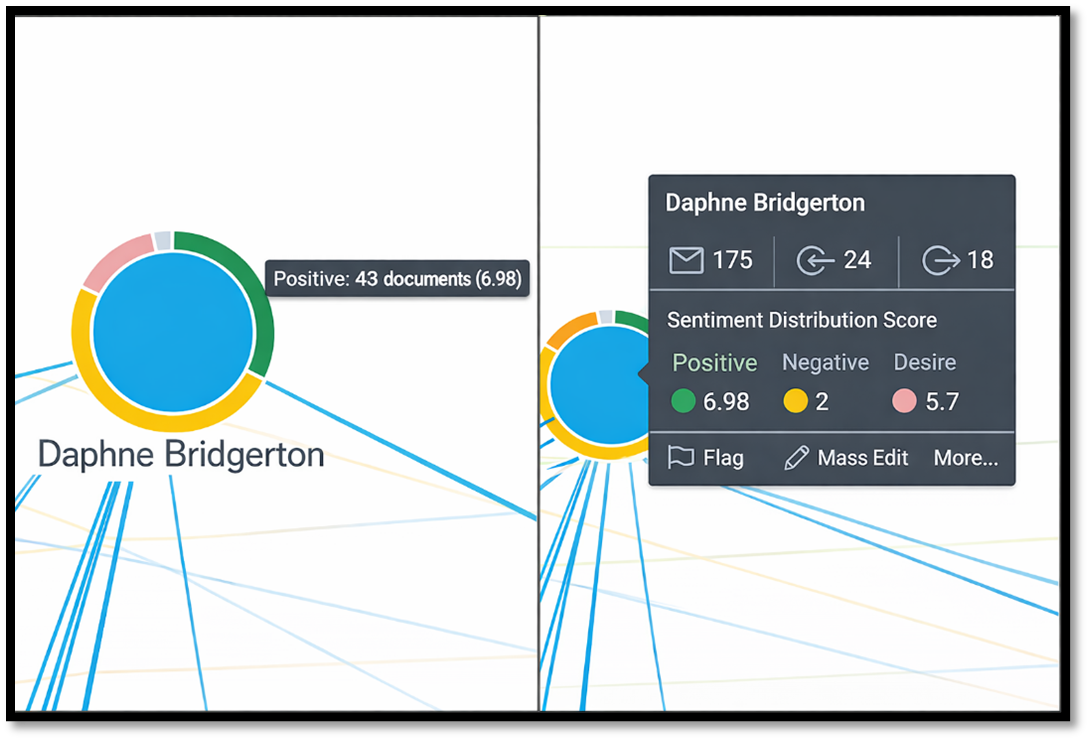
These insights are especially valuable in harassment, wrongful termination, discrimination, exfiltration, and fraud investigations. But their usefulness doesn’t stop there — Sentiment
Analysis is remarkably versatile. Wherever emotions and intent are present, it helps reveal what’s really going on. For creative examples, we recommend Relativity’s blog on leveraging emotional data.
Love Notes from Your Data: Final Thoughts
Don’t just skim the surface — let Sentiment Analysis reveal what your documents are feeling. With guidance from Page One, your team can turn sentiments into actionable, defensible workflows. Because yes, emails have feelings… and we’re here to make sure they don’t get ghosted this Valentine’s Day.